
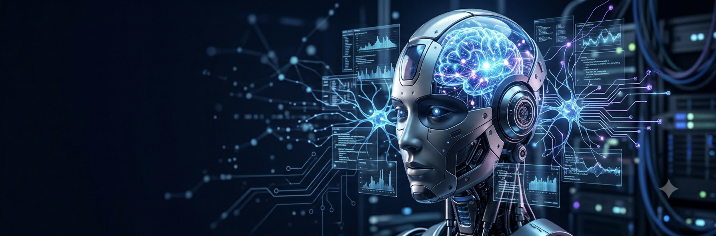
It is a technology that has quietly slipped into your pocket, your hospital, your bank, and your browser. Artificial Intelligence is no longer science fiction — it is the invisible engine running behind the scenes of modern life. But what exactly is AI? Where did it come from? How does it learn? And what happens when it gets things wrong? This is the story of the most consequential technology of our time, told in plain, human language.
Imagine waking up and asking your phone a question. It understands your voice, searches the world’s knowledge, and answers in a natural tone. Minutes later, your bank flags a suspicious transaction before you even notice it. At the hospital, a machine reads a scan and spots a tiny anomaly that a tired human eye might miss. None of this is magic. It is Artificial Intelligence — machines trained to recognise patterns, make decisions, and improve with experience.
But AI did not appear overnight. Its roots stretch back more than seventy years, to a simple and audacious question posed by a British mathematician named Alan Turing.
The Question That Started It All
In 1950, Alan Turing published a paper titled Computing Machinery and Intelligence. In it, he asked a question that would define an entire field: “Can machines think?” He proposed a test — later called the Turing Test — where a human judge would try to distinguish between a machine and a human in conversation. If the machine could fool the judge, it could be considered intelligent.
Six years later, in the summer of 1956, a young computer scientist named John McCarthy gathered a small group of researchers at Dartmouth College in New Hampshire. He coined the term “artificial intelligence” for the workshop, and that meeting is now widely considered the founding moment of AI as a formal field of study.

What followed was not a smooth march of progress. AI went through waves of optimism and disappointment — periods now known as “AI winters” — when funding dried up and promises went unfulfilled. But the field kept evolving. In 1997, IBM’s Deep Blue defeated reigning world chess champion Garry Kasparov. In 2011, IBM’s Watson beat two Jeopardy! champions. And in the 2010s, deep learning exploded, powering breakthroughs in image recognition, speech, and language.
What Exactly Is Artificial Intelligence?
At its core, AI is the ability of machines or software to perform tasks that normally require human intelligence. That includes learning from data, recognising images, understanding language, solving problems, and making decisions. But not all AI is the same.
Artificial Narrow Intelligence (ANI), also called weak AI, is everything that exists today. It is designed for a specific task — recommending a movie, recognising a face, detecting fraud, or translating a sentence. It may be incredibly good at that one job, but it cannot step outside its domain.
Artificial General Intelligence (AGI) is the theoretical ability of a machine to understand, learn, and apply knowledge across any task a human can do. It does not exist yet. Researchers are divided on whether it is years, decades, or generations away.
Artificial Superintelligence (ASI) is the hypothetical stage where a machine surpasses human intelligence in every domain. It remains firmly in the realm of speculation, raising deep ethical questions about control and alignment.
All the AI you have ever used — every chatbot, every recommendation, every voice assistant — belongs to the narrow category. We are still waiting for the general kind.
How Does AI Actually Learn?
Most modern AI is built on machine learning. Instead of being programmed with explicit rules, a machine is fed huge amounts of data and allowed to find patterns. Show a system millions of photos labelled “cat” and “dog,” and it eventually learns to tell them apart on its own.
Deep learning, a subset of machine learning, uses artificial neural networks inspired loosely by the human brain. These networks have many layers, allowing them to learn increasingly abstract features — from edges and shapes in images to grammar and meaning in text. This is the technology behind the generative AI boom that has dominated headlines since the early 2020s.

But here is the catch: AI does not “understand” in the human sense. It does not know what a cat is. It knows that certain pixel patterns are statistically associated with the label “cat.” That distinction matters, because it explains both AI’s remarkable power and its most troubling failures.
AI Is Already Everywhere
You do not need to look for AI. It is already embedded in the systems you use every day. In healthcare, AI models analyse medical images, assist in diagnosis, and help triage patients. In finance, it detects fraudulent transactions in real time. In transportation, it is the brains behind driver-assistance systems. In education, it helps grade assignments, personalise learning, and even draft code.
The numbers tell the story of a technology that has moved from the lab to the centre of the global economy. Gartner estimates that worldwide spending on AI will total $2.52 trillion in 2026, a 44% increase year-over-year, driven largely by infrastructure investment.[reference:0] Surveys suggest that around 88% of organisations now use AI in at least one business function.

Yet adoption and impact are not the same thing. McKinsey found that while 88% of organisations use AI, nearly two-thirds are still running pilots rather than scaling it company-wide. The gap between using AI and benefiting from it is one of the defining business challenges of the decade.
The Other Side of the Algorithm
For all its promise, AI comes with serious risks. And the most important risks are not the sci-fi nightmares of killer robots. They are quieter, more structural, and already here.
Bias is perhaps the most insidious. AI systems learn from data, and data reflects the world as it is — including its prejudices. Models trained on biased hiring records, biased policing data, or biased lending decisions can reproduce and even amplify discrimination.
Job displacement is another growing concern. The World Economic Forum’s Future of Jobs Report 2025 projects that roughly 92 million jobs could be displaced by AI and automation by 2030, even as 170 million new roles are created.[reference:1] The net effect may be positive, but the transition will be painful for many workers.
Misinformation and deepfakes are a third challenge. Generative AI can produce convincing fake text, images, audio, and video at scale. This has already been used to undermine elections, destabilise public health responses, and erode trust in institutions.
And then there is the question of governance. AI is developing faster than the laws meant to regulate it. The UN has warned that without preemptive governance, AI deployment risks deepening inequality and straining environmental resources through its massive energy demands.

The most dangerous AI is not the one that becomes conscious. It is the one that makes decisions about people’s lives using data that was never fair to begin with.
Where Is AI Going Next?
The next phase of AI is already taking shape. Generative AI — systems that create text, images, code, and video — will continue to spread into every industry. Agentic AI, which can take actions and complete multi-step tasks on its own, is moving from research labs into enterprise workflows. Quantum computing is being explored as a future accelerator for AI, potentially unlocking breakthroughs in optimisation and materials science, though broad commercial value remains years away.
At the same time, the conversation is shifting from “What can AI do?” to “How do we use it responsibly?” The organisations and societies that thrive will not be the ones that adopt AI fastest, but the ones that learn to steer it.
Why This Should Stay With You
Artificial Intelligence is not just a technology story. It is a human story. It is the story of a species that looked at a machine and asked, “Can you think?” — and then spent seventy years trying to find out.
AI has already changed how we diagnose disease, how we move, how we communicate, and how we work. It has also exposed our biases, tested our institutions, and forced us to confront uncomfortable questions about what we value and who gets to decide.
The most important question is not whether AI will shape the future. It will. The real question is whether we will shape AI — with intention, with fairness, and with a clear-eyed understanding of both its power and its limits. That is not a job for engineers alone. It is a job for all of us.
Fact-check note: Alan Turing published his foundational paper in 1950; John McCarthy coined the term “artificial intelligence” at the Dartmouth workshop in 1956. Gartner forecasts worldwide AI spending of $2.52 trillion in 2026, a 44% year-over-year increase.[reference:2] The World Economic Forum’s Future of Jobs Report 2025 projects 92 million jobs displaced and 170 million new roles created by 2030.[reference:3] Sources: Wikimedia Commons, Gartner, World Economic Forum, McKinsey.
Image credits: Fig. 1 is public domain via Wikimedia Commons. Fig. 2 is CC BY-SA via Wikimedia Commons. Figs. 3–5 are free-to-use under the Pexels License.
Login with