
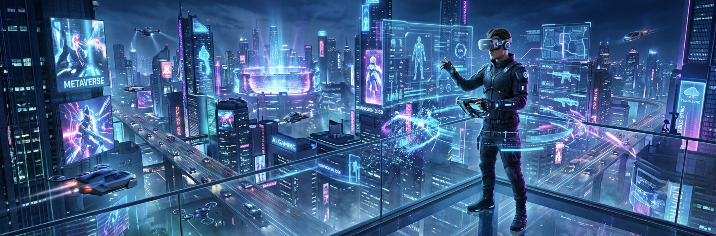
The controller in your hand is already a relic of a fading era. The real revolution is not a new console or a faster graphics card — it is the disappearance of the screen itself. By 2050, gaming will not be something you sit down to do. It will be something you step into. This is the story of how cloud gaming, artificial intelligence, and immersive virtual reality are converging to erase the line between the game and the world around you.
Close your eyes and imagine a Tuesday evening in 2050.
You do not pick up a controller. You do not turn on a console. You walk into your living room, put on a pair of lightweight glasses, and the room dissolves. A cyberpunk megacity flickers into existence around you — neon towers, flying vehicles, holographic billboards. Your squad is already there. One of them is a real person in another country. The others are AI-driven characters who remember your last mission, your tactics, even your sense of humour.
You raise your hand. A glowing energy weapon materialises. The city reacts. The wind changes. A building collapses because you blew out its foundation ten minutes ago, and the debris is still lying in the street. The game is not a level you are playing. It is a place you are inhabiting.
That is the future of gaming. Not better graphics. A different reality.
The End of the Console as We Know It
For fifty years, gaming has been defined by hardware. The video game industry grew up around boxes — Atari, Nintendo, PlayStation, Xbox. Each generation promised more power, and players bought new machines to unlock it. That cycle is already breaking.
The global gaming market is projected to grow from 343.22billionin2025to386.04 billion in 2026, and it is expected to reach $618.82 billion by 2030. But the way people access games is shifting dramatically. Cloud gaming — where the heavy processing happens on remote servers and the game is streamed to whatever screen you own — is growing at breakneck speed. The cloud gaming market is estimated to grow from 19.29billionin2025to28.29 billion in 2026, a staggering 46.6% annual growth rate, and it could reach $130.42 billion by 2030.

Bloomberg Intelligence predicts that the cloud gaming market will reach $38 billion by 2035, and that the dedicated console may eventually become a niche product for collectors rather than the main way people play. AI and data centres are the engine behind this shift. As computing becomes cheaper and more distributed, the box under your TV stops being the centre of the experience. The game follows you.
The console was never the point. It was just the place where the game lived. In the future, the game lives everywhere.
AI: The Player Behind the Curtain
Artificial intelligence is already reshaping how games are made. In 2026, more than 94% of game studios reported using AI in at least one stage of development. Nearly 50% of new games released on Steam in October 2026 declared the use of generative AI content, up from 26.4% a year earlier. On Roblox, more than 80% of the top 100 games by hours played were built with AI assistance.
But the real transformation is not in development. It is in the game itself. In 2050, AI will not just power enemies or generate textures. It will create characters with memory and emotion, environments that respond to your behaviour, and stories that adapt in real time to who you are and how you play. The game will not be a fixed experience designed by a studio. It will be a living system that learns from you.

That shift is already visible in the numbers. The AI in games market is projected to grow from 2.87billionin2025to3.4 billion in 2026. And as AI becomes cheaper and more capable, the line between a game designed by a human and a game generated by a machine will blur.
Virtual Reality: From Gimmick to Gateway
Virtual reality has been the “next big thing” for a decade. In 2050, it will finally be the thing itself. The VR gaming market is projected to grow from 24.33billionin2025to31.92 billion in 2026, and it is expected to reach $93.82 billion by 2030.
The hardware is shrinking. The experiences are deepening. Mixed reality headsets already blend digital content with the physical environment, and future devices will be light enough to wear all day. Imagine walking through your own home while a game overlays a dungeon on your hallway, or sitting on your couch while a virtual stadium erupts around you. The room does not disappear. It transforms.

The screen was never the window. It was the wall. VR does not make the wall bigger. It removes it.
The City That Never Stops Rendering
The visual signature of 2050 gaming will be the cyberpunk megacity — not as a backdrop, but as a living space. Neon skyscrapers, flying vehicles, holographic advertisements, and towering digital displays will not be set dressing. They will be interactive. A billboard might be a quest marker. A flying car might be a transport system you can hijack. The city will be dense, vertical, and reactive.
This is where esports and immersive entertainment collide. Imagine a stadium that does not exist in physical space, where millions of spectators watch a match unfold in a shared virtual arena, each with their own perspective. Imagine a game that is also a social space, a marketplace, and a stage. The metaverse was an early sketch of this idea. The next generation will build the real thing.

The economics are already moving in this direction. The gaming market is forecast to reach $618.82 billion by 2030, driven by subscription models, immersive environments, and metaverse-based platforms. The game is no longer a product. It is a place.
The Challenges Nobody Is Talking About
This future is not automatic. It comes with real problems. Cloud gaming depends on fast, reliable internet, and billions of people still lack it. AI-generated content raises questions about authorship, bias, and the devaluation of human creativity. Virtual reality has physical and psychological costs — motion sickness, isolation, and the strange disorientation of spending hours in a world that does not exist.
And then there is the question of access. If the future of gaming requires expensive headsets, high-speed connections, and subscription fees, it risks becoming a luxury rather than a universal medium. The most important design challenge of 2050 will not be rendering. It will be inclusion.
The most impressive thing a game can do is not make you feel like you are somewhere else. It is make you feel like everyone can come with you. growingto386.04
Why This Should Stay With You
The future of gaming is not about better pixels. It is about the disappearance of the boundary between play and life. The controller fades. The screen dissolves. The game becomes a place you inhabit, shaped by AI, streamed from the cloud, and rendered in real time around your body.
That is a beautiful idea. It is also a responsibility. The games we build in 2050 will not just entertain us. They will shape how we socialise, how we learn, how we compete, and how we understand each other. The question is not whether technology will make this future possible. It already is. The question is what kind of world we will choose to render.
And maybe that is the most exciting part. The future of gaming is not something that happens to us. It is something we play our way into.
Fact-check note: Global gaming market projected at 343.22billionin2025,growingto386.04 billion in 2026 and 618.82billionby2030.Cloudgamingmarketat19.29 billion in 2025, 28.29billionin2026,andpotentially130.42 billion by 2030. VR gaming market at 24.33billionin2025,31.92 billion in 2026, and 93.82billionby2030.9438 billion by 2035 and threaten the traditional console. Sources: Research and Markets, Bloomberg Intelligence, WEF, and industry reports.
Image credits: All images are from Pexels and are free to use under the Pexels License. A placeholder fallback is included so a broken image never appears if a source fails to load.
Login with