
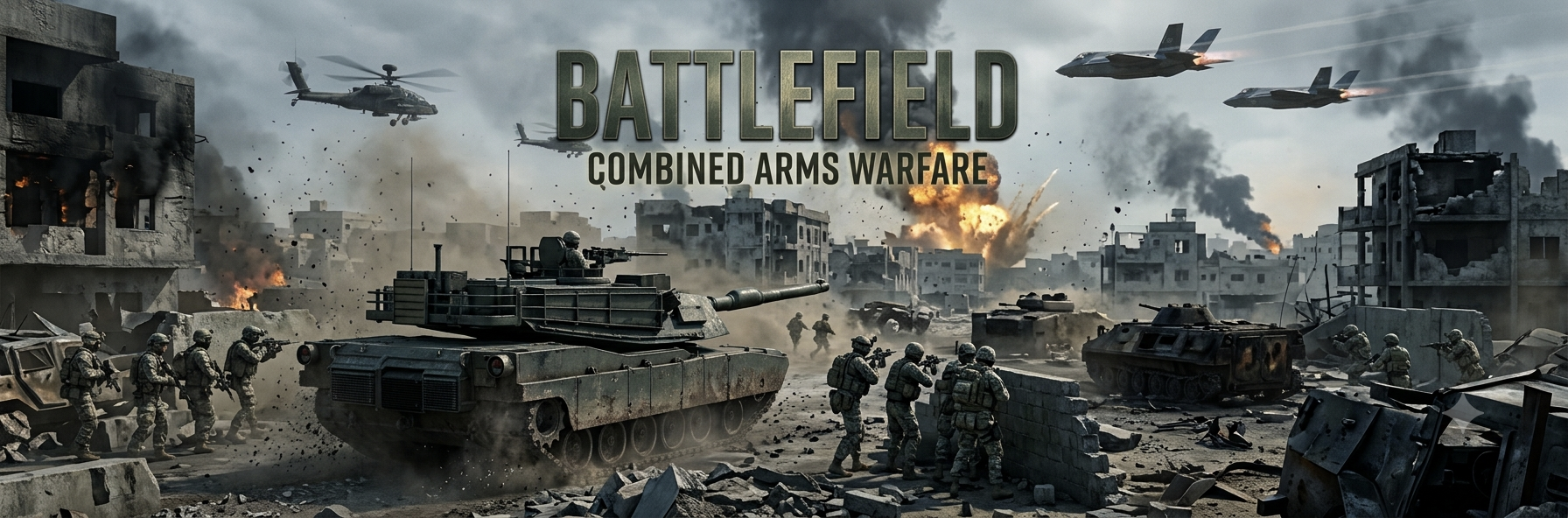
It is not just a shooter. It is a sandbox of war. While other games give you a gun and a corridor, Battlefield hands you a tank, a fighter jet, a rocket launcher, and a building that can be flattened. Since 2002, this franchise has asked a simple question: what happens when you stop treating war as a shooting gallery and start treating it as a chaotic, interconnected battlefield? This is the concept behind Battlefield — not the patch notes, not the reviews, just the idea that changed multiplayer shooters forever.
Close your eyes and picture a battlefield. Not a movie battlefield. A game battlefield.
You are in a squad of four. One of you is a medic. One is carrying rockets to take down a tank. One is a sniper on a hill. And you are the assault, pushing toward a capture point with smoke grenades and a rifle. Above you, a teammate in a fighter jet is trying to clear the sky. Somewhere across the map, an enemy squad is doing the exact same thing. And in the middle of it all, a building you were using for cover is collapsing because somebody put C4 on the foundation.
That is Battlefield. Not a duel. A combined-arms chaos. And once you understand that idea, you understand why this franchise has survived for more than two decades.
The Birth of a Different Kind of Shooter
Battlefield did not start as a blockbuster. It started as a gamble.
In September 2002, a Swedish studio called Digital Illusions CE — now known simply as DICE — released Battlefield 1942 for PC. The pitch was almost absurdly ambitious for its time: large-scale multiplayer battles across huge maps, where players could drive tanks, fly planes, man anti-aircraft guns, and crew naval vessels, all in the same match.
Most shooters of that era were arena games. Small maps. Fast reflexes. Battlefield was different. It was slower, bigger, and it asked players to cooperate. You could not win alone. You needed a gunner in your tank. You needed someone to repair it. You needed a squad that communicated.
The series sold 88.7 million copies worldwide as of November 2022, and that number has only grown since. The latest entry, Battlefield 6, launched in October 2025 and sold over 20 million copies in its first few months, with more than 26 million players including its free-to-play mode. At its peak, it drew 747,440 concurrent players on Steam — a franchise record.
The Three Pillars: Combined Arms, Destruction, Teamwork
Every Battlefield game, good or bad, is built on three ideas. Strip those away, and it stops feeling like Battlefield.
Combined Arms is the first. This means infantry, vehicles, and aircraft all share the same battlefield and all matter. A tank can dominate a street, but a coordinated squad with rockets can stop it. A helicopter can rain fire from above, but a jet can shoot it down. No single tool wins. The combination does.
Destruction is the second. In most shooters, a wall is a wall. In Battlefield, a wall is a suggestion. Buildings can be levelled. Cover can be removed. The Frostbite engine was specifically built to handle this kind of real-time physics and networked destruction at scale.

Teamwork is the third, and the most important. Battlefield is not a game you can solo-carry. Squads are the basic unit of play. You spawn on your squadmates. You revive them. You resupply them. You mark targets for them. The series has always rewarded players who play together, and punished those who run off alone.
In Battlefield, the hero is not the player with the most kills. It is the squad that works together to hold a point while the building around them is falling apart.
A Franchise That Travels Through Time
One of the strangest and most interesting things about Battlefield is that it has no fixed era. It jumps across history like a time traveller with a preference for conflict.
It started in World War II with Battlefield 1942. It moved to modern warfare with Battlefield 2 and Battlefield 3. It went to the future with Battlefield 2142. It went back to World War I with Battlefield 1 in 2016, and then to World War II again with Battlefield V. It even stepped outside the military entirely with Battlefield Hardline, which reimagined the formula as a cops-versus-criminals war on crime.

That flexibility is part of the concept. Battlefield is not a story about one war. It is a framework for large-scale warfare, and that framework can be dressed in any era. The weapons change. The vehicles change. The maps change. But the core loop — combined arms, destruction, teamwork — stays the same.
The Engine Behind the Chaos
You cannot have a battlefield where buildings collapse, tanks flip, and jets crash into the ground without a serious piece of technology underneath. That technology is the Frostbite engine.
Frostbite was developed internally at DICE and has been evolving for over a decade. It was designed specifically for large-scale destruction, real-time physics, and networked gameplay — the exact things Battlefield needs. DICE’s senior producer has said that Battlefield’s unique destruction mechanics would not be possible on a generic engine like Unreal Engine 5, because Frostbite has custom modules built for this specific kind of chaos.
That is not marketing talk. It is the reason a Battlefield match feels different from any other shooter. The environment is not a backdrop. It is part of the fight. You can create new sightlines by blowing holes in walls. You can deny cover by levelling a building. You can change the shape of the map with enough explosives. The game is not just about where you shoot. It is about what you destroy.
Why Battlefield Matters
Battlefield is not the biggest shooter franchise in the world. It is not the most accessible. It has had spectacular highs and embarrassing lows. But it matters because it proved something important: that multiplayer shooters could be strategic, not just reflexive.
It proved that players enjoy chaos, as long as that chaos has structure. It proved that vehicles and infantry can share a space without one dominating the other. And it proved that destruction is not a gimmick — it is a design language. When a building falls, the match changes. When a bridge is destroyed, the flow of the battle shifts.

The series has also influenced the broader industry. The idea of large-scale, objective-based multiplayer with vehicles and destructible environments has echoes in countless other games. And the Battlefield formula — the squad spawn, the class system, the vehicle sandbox — has become a reference point for what a “big” multiplayer game can be.
Battlefield is not a game about being the best soldier. It is a game about being part of the best squad. That distinction is the whole franchise in one sentence.
Why This Should Stay With You
The next time you see a Battlefield trailer and it looks like a Michael Bay movie — explosions, collapsing buildings, jets screaming overhead — remember what is actually happening underneath. It is not just spectacle. It is a design philosophy.
It is the idea that a battlefield should feel like a place, not a level. That it should have rules, but also room for improvisation. That the environment should be as dangerous as the enemy. And that the most satisfying moment is not a headshot, but a coordinated squad push that takes a point while the world is falling apart around you.
That is the concept of Battlefield. Not a game about war, but a game about the chaos of war — and the strange, beautiful teamwork required to survive it.

Fact-check note: Battlefield 1942 was released on September 10, 2002, developed by Digital Illusions CE (DICE) and published by Electronic Arts. The series had sold 88.7 million copies as of November 2022. Battlefield 6, released in October 2025, sold over 20 million copies and drew 747,440 concurrent Steam players at launch. The series is built on the Frostbite engine, designed for large-scale destruction and physics. Sources: Wikipedia, ScreenRant, GameRant, EA.com, Steam player data.
Image credits: All images are from Pexels and are free to use under the Pexels License. Representative images have been used for illustrative purposes; no official Battlefield game assets are included.
Login with