
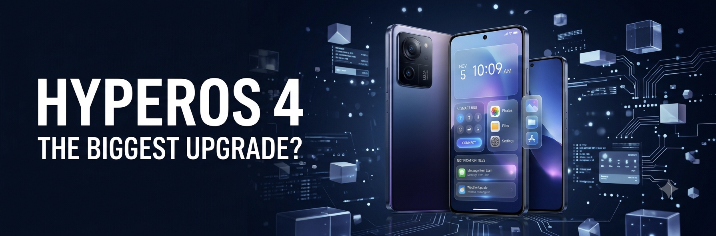
It is not just another Android skin update. It is a glass-redesigned, AI-first operating system built on Android 17 — and it is rolling out to more than 80 Xiaomi, Redmi, and POCO devices across three waves. While other brands hand you a new wallpaper and call it an upgrade, Xiaomi has rebuilt the visual language, pushed AI deep into the system, and rewritten the performance layer underneath. This is the concept behind HyperOS 4 — not the changelog, not the marketing slides, just the idea that software can finally feel like a first-class product.
Close your eyes and picture your phone after the update. Not a spec sheet. The actual experience.
You unlock it and the lock screen has a colourful clock you picked yourself. Notifications arrive as soft translucent cards instead of flat blocks. You swipe into the control centre and it feels lighter, more modular, less crowded. You open five apps in a row and none of them reload. You open your gallery with 10,000 photos and it scrolls instantly instead of stuttering for three seconds. And somewhere in the background, an assistant is quietly chaining tasks together instead of waiting for you to ask one question at a time.
That is HyperOS 4. Not a version bump. A rebuild. And once you understand that idea, you understand why Xiaomi is treating this release differently from the last five.
The Release That Refuses to Be Just a Version Number
Xiaomi has shipped a lot of software over the years. HyperOS 4 is the first one in a while that feels like it was designed rather than assembled.
The stable update started rolling out globally in early November 2026, and Xiaomi has published a three-wave schedule covering 82 phones and tablets across its main brand, Redmi, and POCO. If you own a Xiaomi device from the last two or three years, there is a decent chance it is on the list.
Strip away the marketing language and three things stand out: a new Soft Light Glass design, a genuinely faster system underneath, and an AI assistant that is finally trying to do things rather than just answer questions. Everything else — the bullet points, the percentages, the device lists — hangs off those three ideas.
Soft Light Glass: Transparent, Layered, Familiar
The first thing you will notice is the interface. Xiaomi calls it Soft Light Glass, and yes — it looks a lot like Apple’s Liquid Glass language. Translucent panels, layered notifications, redesigned lock screens, and a control centre that feels lighter and more modular.
Xiaomi is not pretending this is entirely original. The company is leaning into the glass-inspired look because it is the direction the industry is moving — Google’s Android 17 has similar translucent effects, and OPPO is doing the same with ColorOS 17. The question is not whether the inspiration is obvious. It is whether the execution is good.

From early hands-on impressions, the answer is mostly yes. The glass effects are subtle rather than excessive. The lock screen gets more customisation — colourful clocks, flexible layouts — and home screen folders can finally be resized, which sounds minor until you have lived with fixed folder grids for years.
There is a catch, though. Glass effects are expensive to render. Real-time blurring and translucent layers eat GPU resources, and on older or mid-range hardware that can mean frame drops or battery drain if the system is not carefully optimised. Xiaomi says it has done the work. Whether that holds up on a three-year-old Redmi Note is a different question — and one only real-world usage will answer.
Glass design is easy to show in a keynote and hard to hold at 60 frames per second on a budget phone. That gap is where most software promises die.
The Numbers Xiaomi Is Claiming
Underneath the glass, HyperOS 4 is built on Android 17 (with some devices receiving it alongside Android 16, depending on their existing HyperOS 3 branch). But the more interesting changes are Xiaomi’s own optimisations.

According to Xiaomi’s claims, HyperOS 4 reduces system size by around 30%, cuts memory usage by 25–30%, and speeds up cold app launches by 35–40%. Background app retention is said to jump from 65% to 91% — meaning you can keep five or six common apps open without them reloading when you switch back. CPU idle power consumption is down by 19%, and battery life on the same hardware is claimed to improve by 15–20%.
Not all of those numbers will translate perfectly to every device. But the direction is consistent with what Xiaomi has been doing across recent releases: fewer background processes, smarter memory preloading, and more aggressive workload scheduling. Xiaomi specifically claims 33% faster memory preloading even after eight hours of continuous use, and a 90% reduction in the time it takes to scan a library of 10,000 photos.
The photo-scanning improvement matters more than it sounds. Gallery lag is one of the most common complaints on older Android phones, and a 90% cut in scan time is the kind of fix users actually notice without being told to notice it.
Super XiaoAi 2.0: AI That Tries to Do Things
HyperOS 4 is Xiaomi’s first serious “AI-first” operating system, and the centrepiece is Super XiaoAi 2.0, powered by Xiaomi’s own MiMo large language model.
The pitch is not just a smarter voice assistant. Xiaomi is pushing what it calls “action-oriented intelligence” — an assistant that can understand context, chain together multi-step tasks, and call on system tools and cross-device services without you walking it through every step.
In practice, that means on-screen AI suggestions, structured voice-to-text input, real-time translation, and an input method that can rewrite and polish what you are typing rather than just transcribing it. Recorder and Notes get AI summaries and task extraction. And HyperIsland — Xiaomi’s take on the dynamic island — now supports over 130 services, pulling more live notifications and updates into one place.
Whether Super XiaoAi 2.0 actually feels useful or just adds another layer of prompts is the biggest open question. On-device AI is still inconsistent across the industry, and Xiaomi’s track record with assistant features has been mixed. But the ambition is clear: HyperOS 4 wants the assistant to be part of the workflow, not a separate app you open when you are bored.
The hardest part of an AI assistant is not answering a question. It is knowing which app to open, what to type into it, and when to stop asking you for confirmation. That is the line Xiaomi is trying to cross.
Three Waves, Eighty-Two Devices
Xiaomi is rolling HyperOS 4 out in three phases. The dates below are rollout windows, not guaranteed installation dates — availability can vary by region and device.
| Wave | Timing | Key devices |
|---|---|---|
| Wave 1 | Early November 2026 | Xiaomi 17 Ultra, Xiaomi 17, Xiaomi 17T Pro, Xiaomi 17T, Xiaomi 15 Ultra, Xiaomi 15; POCO F8 Ultra/Pro, X8 series, M8 series, C95 Pro, C85; Redmi Note 17 series, Note 15 series, Redmi 17 series, Redmi 15 series; Xiaomi Pad 8 Pro and Pad 8 |
| Wave 2 | Mid-November 2026 | Xiaomi 15T Pro, Xiaomi 15T; POCO F9 Ultra/Pro, F7 Ultra/Pro, F7, X7 Pro; Xiaomi Pad 7 Pro, Pad 7, Pad Mini; Redmi Pad 2 Pro series; POCO Pad X1 and M1 |
| Wave 3 | December 2026 | Xiaomi MIX Flip, Xiaomi 14 series, Xiaomi 13 series; Redmi Note 14 series, Redmi 15 series, Redmi 14S, Redmi A7 Pro; POCO F6 series, X8s, X7, X6 Pro, M8s, M7, C81 Pro; Xiaomi Pad 6S Pro 12.4, Redmi Pad 2 series, POCO Pad C1 |

The list is unusually broad for a major Android upgrade. Xiaomi is including devices going back to the Xiaomi 13 series, which launched in 2022, and even budget models like the Redmi 15C and POCO C85. That is a longer support window than many flagships from other brands receive — and in a market where software support has become a buying decision, it is a real argument, not a footnote.
One More Thing: Better iPhone Integration
HyperOS 4 also deepens cross-platform sharing with Apple devices. Users can now share photos, files, contacts, and web pages more easily with iPhone users. It is not full ecosystem parity — nothing on Android is — but it is a practical quality-of-life improvement for people who live in mixed-device households or work across both platforms.
It is a small feature with a large signal: Xiaomi is no longer designing only for people who own nothing but Xiaomi.
Why This Should Stay With You
The next time you see a HyperOS 4 launch presentation and it looks like a design showreel — glass panels, floating cards, an assistant finishing your sentences — remember what is actually happening underneath. It is not just spectacle. It is a company deciding that software is worth investing in, not just shipping.
HyperOS 4 is not a revolution. The glass design is clearly inspired by Apple, and some of the AI features will take time to mature. But it is a substantial, broadly available upgrade that addresses real pain points: app loading, memory management, gallery performance, and battery life. If you own a supported device, it is worth installing — especially on older hardware, where the gains are most noticeable. On a flagship that already runs smoothly, the appeal is the interface and the AI, not the raw speed.

That is the concept of HyperOS 4. Not a skin on top of Android, but a statement that the layer is the product — and for a company that ships as many devices as Xiaomi does, that distinction is the whole thing.
Fact-check note: HyperOS 4 is based on Android 17 and began rolling out globally in early November 2026 in three waves, covering 82 phones and tablets. The Soft Light Glass design, Super XiaoAi 2.0 with MiMo, and performance claims (30% smaller system, 25–30% lower memory usage, 35–40% faster cold app launches, 33% faster memory preloading, 90% faster 10,000-photo scanning) are based on Xiaomi’s official claims and early hands-on reports. Device lists and rollout timings are sourced from Xiaomi’s published global schedule and coverage from Android Authority, Gadgets360, and Digit. Battery and performance improvements will vary by device and usage. The iPhone sharing feature is confirmed in Xiaomi’s HyperOS 4 documentation.
Image credits: All images are from Pexels and are free to use under the Pexels License. Representative images have been used for illustrative purposes; no official HyperOS 4 assets are included. Fig. 1: Steve A Johnson; Fig. 2: Jimmy Chan; Fig. 3: Tim Witzdam; Fig. 4: Phong Thanh; Fig. 5: Andrey Matveev.
Login with