
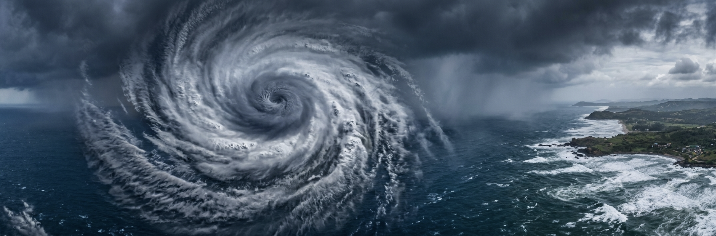
Some storms arrive quietly. Cyclone Murasu did not. Its name comes from the Tamil word for a war drum — a warning beaten loudly before danger arrives. In early November 2026, that warning became real for the coast of Andhra Pradesh. This is the story of how the storm formed, where it hit, what it left behind, and what it teaches us about living beside the Bay of Bengal.
Every cyclone carries a name, but “Murasu” carries a little more meaning than most. In Tamil, murasu means a large drum — the kind once beaten to announce a battle, a festival, or an approaching danger. It is a fitting name for a storm that made people sit up and pay attention.
The name also answers a common question: why would a cyclone heading toward Andhra Pradesh have a Tamil name? The answer lies in how cyclones in the North Indian Ocean are named. Countries in the region suggest names, and those names are used in a fixed alphabetical order. Murasu was already on the approved list, and it was the first Tamil name to be assigned to a tropical cyclone since the naming system began in September 2004. It refers to a traditional Tamil percussion instrument, and the name was proposed through the Regional Meteorological Centre in Chennai. It was not chosen because of where the storm was going; it simply came up in turn.
The India Meteorological Department, or IMD, assigns a name once a system’s sustained winds reach at least 62 kmph, or 34 knots. Before that, it is just a low-pressure area or a depression. After that, it becomes a named storm — and a named storm is a storm people need to prepare for.
How a Cyclone Is Born: Warm Water, Wet Air, and a Spinning Engine
A cyclone does not appear out of nowhere. It needs a recipe, and the main ingredient is warm ocean water. The sea surface needs to be at least 26.5°C, and that warmth should run about 50 metres deep. Warm water heats the air above it. The air picks up moisture and rises.
As the moist air rises, it cools, condenses, and turns into clouds and rain. That process releases heat, which makes the low-pressure area even lower. More air rushes in from outside, and the cycle feeds itself. The Earth’s rotation gives the moving air a twist, and the whole system begins to spin. In simple words, a cyclone is a giant engine that runs on warm ocean water and its own released heat.

A cyclone is not just wind. It is a self-feeding weather engine — and the Bay of Bengal is one of its favourite workshops.
Why Two Storms in One Week?
One of the most striking things about Murasu was its timing. It followed closely after another system, Cyclone Arnab. Normally, a cyclone churns up the ocean and leaves cooler water behind, which makes it harder for the next storm to form quickly. But the post-monsoon season in the Bay of Bengal behaves differently.
During October and November, river water flowing into the sea forms a fresh, lighter layer on top of the salty ocean. That layer can stop deeper, cooler water from mixing upward. As a result, the surface stays warm even after one storm has passed. At the same time, wind shear — the change in wind speed and direction with height — is often lower in this season. Lower wind shear lets a storm grow taller and stronger. Together, these conditions gave Murasu the fuel and the calm air it needed to develop quickly.

Landfall: The Night the Drum Beat Loudest
The landfall process began around 1 a.m. on Tuesday, 3 November 2026, near Ongole in Prakasam district, Andhra Pradesh. The storm crossed the coast between Nellore and Narasapur with maximum sustained winds of 100–110 kmph, gusting to 120 kmph. The IMD classified it as a Severe Cyclonic Storm.
The wind was only part of the danger. The sea rose too. A storm surge of up to 1.5 metres was possible on the coast, pushing water toward low-lying areas and increasing the risk of flooding. After landfall, the storm gradually weakened, with wind speeds dropping from around 100 kmph to about 50 kmph. But by then, it had already left its mark on the coast.
The Damage Left Behind
When the wind died down, the coast began to count the cost. The numbers tell a story of a storm that was not the strongest in memory, but still destructive enough to disrupt lives and livelihoods.
More than 52,459 hectares of crops were damaged, especially paddy and cotton. At least 2 deaths were reported. 312 houses were damaged. Over 2,750 electricity poles were brought down, causing widespread power cuts. Thousands of trees were uprooted, and roads and communication networks were disrupted. Several fishing boats were wrecked off the Prakasam coast. The preliminary loss to property was estimated at around ₹343–344 crore, or roughly 38 million USD.
These figures are more than statistics. Each number represents a field lost, a home damaged, a night without power, or a family forced to move. Cyclones are measured in kilometres per hour, but their real scale is human.

Preparedness: The Quiet Hero of the Story
Amid the damage, there was also an important lesson in what went right. Authorities had time to act, and many people were moved to safety before the worst of the storm arrived.
More than 10,805 people were evacuated to cyclone shelters, and around 12,230 people were accommodated in rehabilitation centres. 171 relief camps were set up and 14,810 food packets were distributed. 11 NDRF teams and 13 SDRF teams were deployed for rescue and relief operations across 132 mandals in 15 districts. 613 generators were arranged to restore essential power supply. As a precaution, 3,066 pregnant women and 1,008 nursing mothers were relocated to hospitals. Helplines and the Mana Mitra WhatsApp service were activated to help people get information and assistance.
This is what preparedness looks like. It is not dramatic. It is buses moving people before the wind rises, shelters opening before the rain arrives, and food packets being packed while the sky is still clear. It is the boring work that saves lives.

What Cyclone Murasu Teaches Us
Cyclone Murasu was a weather event, but it was also a reminder. It reminded us that the Bay of Bengal is one of the most active cyclone basins in the world. Its warm waters and changing seasonal winds make it a place where storms can form quickly and move toward densely populated coasts.
It also reminded us that names matter. A name like Murasu is not just a label. It is a warning beaten loudly enough for people to hear. And it reminded us that preparation is not a small thing. Evacuation, shelters, relief camps, and early warnings may not make headlines the way a storm does, but they are the reason many families have a home to return to.
The most powerful thing about a cyclone is not its wind. It is how much warning we have — and what we do with it.
The next time you hear a cyclone name on the radio or see an alert on your phone, remember Murasu. It was a storm that beat its own drum. The least we can do is listen.

Fact-check note: Landfall near Ongole, Andhra Pradesh, on 3 November 2026, with winds of 100–110 kmph gusting to 120 kmph. “Murasu” means “drum” or “war drum” in Tamil; it was the first Tamil name for a North Indian Ocean cyclone. Damage: 52,459 hectares of crops damaged, 312 houses destroyed, 2,750 electricity poles down, and at least 2 deaths. Relief: 10,805+ evacuated, 171 relief camps, 11 NDRF and 13 SDRF teams deployed. Economic loss: approximately ₹343–344 crore (around 38 million USD).
Image credits: All images are either public domain (NASA/Wikimedia Commons) or free-to-use under the Unsplash License. Representative images have been used where a specific photograph of Cyclone Murasu was not available under a free license.
Login with