
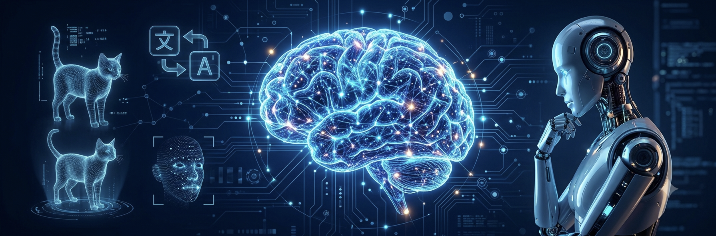
Your phone recognizes your face. YouTube knows what you want to watch next. Google Translate turns Hindi into German in seconds. And it all feels like magic. But behind every one of these "smart" features sits a surprisingly simple idea: a digital imitation of the human brain. This is the story of the neural network — not the math, not the code, just the beautiful concept of how a machine learns to learn.
Imagine teaching a child to recognise a cat. You do not give them a rulebook. You do not say, "A cat has two triangular ears, a small pink nose, and exactly fourteen whiskers." You just point. "Cat." And again. "Cat." After a hundred cats, the child just knows.
A neural network learns the same way. It is not given rules. It is shown examples. And somewhere in its millions of tiny adjustable dials, it builds its own internal sense of what a cat looks like. Nobody programs that sense into it. It discovers it. That is the whole idea. Everything else is engineering.
The Big Idea: Copying the Brain, Not the Rules
Your brain is not a computer that follows instructions. It is a network of roughly 86 billion neurons, each connected to thousands of others. When you see a face, millions of these neurons fire together in a pattern. No single neuron knows what a face is. The pattern does.
Artificial neural networks borrow this idea loosely. They are made of simple computational units called artificial neurons, connected in layers. Each connection has a weight — a number that controls how strongly one neuron influences another. And each neuron has a bias — a small threshold that decides how easily it "wakes up".
That is it. That is the entire vocabulary. Neurons, connections, weights, biases. Tune these numbers correctly, and the network can recognise a face, translate a language, or beat a world champion at Go.

Picture It as a Factory Line
Here is the simplest way to visualise what happens inside.
Imagine a factory assembly line. Raw materials enter at one end. At the first station, a worker does one small job — say, checks the colour. At the next station, another worker checks the shape. The next checks the texture. By the end of the line, the finished product is recognised: "This is a cat."
A neural network works exactly like this. The input layer receives the raw data — the pixels of an image, the words of a sentence. The hidden layers in between do the step-by-step processing. The first hidden layer might detect simple edges. The next might combine edges into shapes. The next might recognise textures. By the final layers, the network has built something complex enough to say, "cat" or "not cat".
A neuron does not "understand" a cat. It just learns which patterns of pixels tend to appear together. The understanding lives in the whole network, not in any single part.
How the Dials Get Tuned: Learning by Being Wrong
Here is the part that makes it all work. At the start, every weight and bias is set to a random number. The network is terrible. Show it a cat, and it might confidently say "airplane."
So it makes a guess, checks the answer, and measures how wrong it was. Then it goes backward through the network and nudges every single dial — every weight, every bias — a tiny bit in the direction that would have made the answer slightly less wrong. This backward correction is called backpropagation. The nudging process is called gradient descent.
Then it does it again. And again. Millions of times. With every pass, the dials get a little closer to the right settings. The error drops. The guesses get better. After enough iterations, the network can look at a cat it has never seen before and say, "cat" — without anyone ever writing a rule about ears or whiskers.

This is why neural networks need so much data. A child might learn "cat" from twenty examples. A network might need twenty thousand. But it never complains, never gets tired, and never forgets what it learned.
Not All Networks Think the Same Way
Just as there are different kinds of hammers for different jobs, there are different kinds of neural networks for different kinds of data.
Feedforward networks are the simplest. Data flows one way, from input to output. They are used for basic classification and regression tasks.
Convolutional Neural Networks (CNNs) are the eyes of AI. They are designed for images. Instead of looking at every pixel independently, they look at small patches — edges, corners, textures — and build up an understanding of the whole image piece by piece. When your phone unlocks with your face, a CNN is doing the recognising.
Recurrent Neural Networks (RNNs) have memory. They are designed for sequences — sentences, speech, time-series data. They do not just look at one input; they remember what came before.
Transformers are the newest and arguably the most important. They use a mechanism called attention to decide which parts of the input matter most to each other. Every modern large language model — the kind powering the chatbots you use every day — is built on this architecture.
You Use Them Every Day Without Knowing
Neural networks are not locked in research labs. They are already woven into the fabric of daily life. When you unlock your phone with your face, a CNN is at work. When you type a message and your keyboard predicts the next word, a language model is guessing. When your photo app automatically groups pictures of the same person, a neural network is sorting them.
In hospitals, CNNs analyse X-rays and scans to flag anomalies. In banks, they detect fraudulent transactions in real time. In cars, they power lane detection and driver-assistance systems. In agriculture, they help identify crop diseases from leaf photos. The list is already enormous, and it is growing every month.

The most powerful technology of our time is not the one you notice. It is the one that quietly makes everything else work better.
But They Are Not Magic — And They Are Not Human
Here is the honest part. A neural network does not "understand" anything. It does not know what a cat is. It knows that certain numerical patterns are statistically associated with the label "cat." That distinction is not nitpicking. It explains almost every failure mode.
Neural networks are black boxes. You can see the inputs and the outputs, but the billions of internal weights are too complex for any human to interpret. This is fine for recommending movies. It is terrifying for deciding who gets a loan or who gets parole.
They are also only as good as their data. Train a hiring network on historical data where men were favoured, and it will learn to favour men. Train a facial recognition system on mostly light-skinned faces, and it will fail on dark-skinned faces. The bias is not in the algorithm. It is in the world the algorithm learned from.
And they are fragile. A neural network that recognises cats with 99% accuracy can be fooled by changing a few pixels that no human eye would notice. It is confident, but it is not careful.
Why This Should Stay With You
The neural network is one of the most beautiful ideas in modern science, not because it is complicated, but because it is simple. Take a few million adjustable dials. Show the machine examples. Let it be wrong. Let it correct itself. Repeat until it is right.
That is the entire trick. Nobody programmed the rules of grammar into a language model. Nobody taught a CNN the geometry of a face. They learned it. From data. From mistakes. From repetition. In a way that is strangely, almost uncomfortably, similar to how a child learns.
And yet, for all that similarity, the machine is not a child. It has no curiosity, no intention, no understanding. It is a mirror held up to the data we feed it — brilliant at finding patterns, blind to meaning, and entirely dependent on the choices of the humans who built it.
That is the real lesson of the neural network. The question is not whether machines can learn. They clearly can. The question is what we teach them, and whether we are honest about what they actually are: not minds, but mirrors. Powerful mirrors, shaped by us, reflecting back both our intelligence and our blind spots.
Fact-check note: The human brain contains roughly 86 billion neurons. The perceptron, the first trainable neural network, was introduced by Frank Rosenblatt in 1958. Backpropagation was popularised in the 1980s and became the foundation of modern deep learning. CNNs are designed for spatial data such as images; RNNs are designed for sequential data; Transformers rely on attention mechanisms and power modern large language models. Sources: IndiaAI, Microsoft Learn, Digital Trends, and peer-reviewed deep learning literature.
Image credits: Figs. 1–2 are CC BY-SA via Wikimedia Commons. Figs. 3–4 are free to use under the Pexels License. Representative images have been used for illustrative purposes.
Login with