
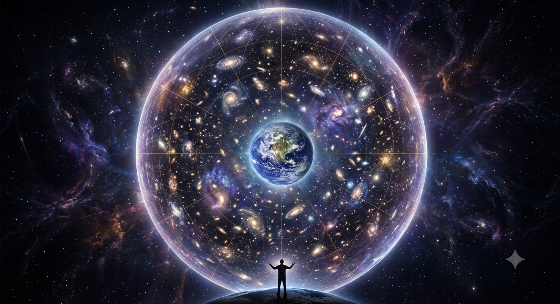
The universe is 13.8 billion years old. So how wide is it? If you are quick at maths, you might guess about 27.6 billion light-years across. The real answer is 93 billion light-years — nearly three times wider than the age of the universe should allow. Nothing travelled faster than light. The trick is that space itself was stretching the entire time. Here is the simple, human version of why the universe is far bigger than it has any right to be.
Okay, forget the equations for a minute. Just picture this.
Light is the fastest thing in the universe. Nothing beats it — not a rocket, not a laser, not even information. It moves at about 300,000 kilometres per second. A light-year is simply how far light travels in one year. So if something is 10 light-years away, you are seeing it as it looked 10 years ago. If it is 13 billion light-years away, you are seeing it as it looked 13 billion years ago — right near the beginning of everything.
The universe is 13.8 billion years old. So the edge of everything we can see should be roughly 13.8 billion light-years away, right? That would make the visible universe about 27.6 billion light-years across.
That is not what we find. The observable universe is about 93 billion light-years in diameter. Almost three times wider than it should be if things were simply flying apart in a fixed space.
That sounds like a violation of physics. It is not. And the reason is genuinely one of the most beautiful ideas in all of science.
The Secret: Space Itself Is Stretching
We are used to thinking of the universe as stuff moving through an empty room. Galaxies are like marbles rolling apart across a table.
That is not what is happening.
The table is stretching. Space is not an empty backdrop — it is a thing. It has a fabric, it bends around heavy objects, and since the Big Bang it has been expanding. Not exploding outward into pre-existing emptiness, but stretching in every direction at once, everywhere.
Here is the part that breaks most people’s brains. The galaxies are not racing away through space. They are, in a very real sense, standing still. The space between them is growing. It is like dots painted on the surface of a balloon: as you inflate the balloon, the dots drift apart — but the dots never crawled across the rubber. The rubber itself expanded and carried them with it.
That is why nothing violates the speed of light. No object is breaking the limit. Space is simply adding more space in between, and the effect adds up over billions of years.
Nothing in the universe is moving faster than light. Space is just getting bigger faster than light can cross it.
Why 93 Billion and Not 27.6 Billion?
Think about what light has actually been doing for 13.8 billion years.
A photon that left a distant galaxy shortly after the Big Bang has been travelling towards us ever since, at the speed of light. But while it travelled, the space it was moving through kept stretching. The finish line kept moving away. So by the time that photon finally reaches your eye today, the galaxy that emitted it is much farther away than the distance the light covered.
The current measurement is that the observable universe has a radius of about 46.5 billion light-years. Double it and you get roughly 93 billion light-years across. That is the size of the sphere of space whose light has had time to reach us.
And here is the bit that should make you sit back in your chair: that 93-billion-light-year sphere is not the whole universe. It is only the part we can see. Everything beyond that horizon is almost certainly out there right now — galaxies, stars, planets, possibly other civilisations — but their light has not had time to reach us yet. The universe is expanding faster than light can cross it, so some of it will never become visible to us. Not in a billion years. Not ever.
There is a boundary to what we can know, and it is not a wall. It is a horizon. And it is expanding away from us every second.
And There Is No Centre
The natural next question is: if the universe is expanding, where is it expanding from? Where is the centre?
There isn’t one. This is the second half of the mind-bender.
Every point in space is moving away from every other point, and every observer everywhere sees the same thing: the universe expanding around them. An astronomer in a galaxy 10 billion light-years from here would measure the same 93-billion-light-year observable universe centred on themselves. Their horizon is different from ours, but equally valid.
The Big Bang did not happen at a point in space. It happened at a moment in time. It happened everywhere at once, because everywhere was closer together. Asking “where did the Big Bang happen?” is a bit like asking “where is the edge of the Earth?” — the question is built on an assumption that turns out not to be true.
Bonus Fact: You Are Moving at 2.1 Million km/h Right Now
While you were reading this, the Earth spun you at about 1,600 km/h. It carried you around the Sun at 107,000 km/h. The Sun dragged us around the Milky Way at 828,000 km/h. And the Milky Way itself is falling toward a region called the Great Attractor at roughly another 1.3 million km/h.
Add it all up, and you are hurtling through the cosmos at roughly 2.1 million kilometres per hour — about 580 km every second — while sitting perfectly still in a chair, feeling absolutely nothing.
Because motion is only measurable relative to something else, and space is not a fixed background you can feel yourself moving against. Your body is not built to detect it. You are a passenger on a rock, on a star, on a galaxy, all falling through an expanding universe at the same time — and your brain simply reports it as “sitting”.
You have never, not for a single second of your life, been still. You have simply never had anything to compare it to.
Why This Should Stay With You
Most “space facts” are trivia. This one is different, because it quietly rewires how you see everything around you.
- Every time you look at the night sky, you are looking backwards in time. The Andromeda galaxy is 2.5 million light-years away — you are seeing it as it was before humans existed.
- The universe is bigger than its own age allows. Not because physics is broken, but because space itself has been stretching the whole time.
- There is a horizon, and it is moving. Some of the universe will always stay out of reach. It will never be seen by anyone, ever.
- There is no centre and no edge. Every point is equally special, and equally ordinary.
And yet, from a small rock orbiting an ordinary star in an ordinary galaxy, a species that has existed for a cosmic eyeblink figured all of this out — with telescopes, mathematics and a stubborn refusal to accept that the obvious answer is the right one.
That might be the most mind-blowing fact of all. Not the size of the universe, but the fact that a part of it learned how to measure itself.
Login with